Why is it that whenever I water the garden it pours with rain the next day?
Today it is overcast and very wet. We have had a few days of nice weather. I have been able to sit in the swing-chair in the garden and read. Unfortunately we have been visited by a pair of magpies. Despite their smart black and white suits, they are the most unpleasant of birds. Scattered about the grass are the remains of the bird's eggs they have eaten and my reading is interrupted by the coarse chut-chut chattering that they constantly make.
While other parts of the country are sweltering under temperatures in the eighties, it has been pleasantly cool here on the coast, around 75 with a cooling breeze sufficient to move the tree tops but not enough to stir the lower branches. The skies have been mainly blue with high clouds that Catholics see pictures of Jesus in, but I only see clowns and grotesque faces.
Today is much different. We are driving up to see my sister-in-law and then my mother this afternoon. I couldn't have done it yesterday. I had run out of ranitidine and substituted lanzoprazole. This gave me so much retained and trapped wind that I was unable to do anything but sit. I have replenished my supply of Zantac today.
I still have a tendency to become drowsy after meals, but this is just diversion of blood from brain to stomach and I believe a lot of older people have the problem. Not all the 19 explanations of my poor health are wrong, just because one is right.
Showing posts with label miscellany. Show all posts
Showing posts with label miscellany. Show all posts
Thursday, August 04, 2011


Saturday, February 12, 2011
Skin lightening
I am often asked how I manage to cover so many different topics on this blog. Regular readers will know that by far the largest number of postings are about CLL and this is because I make a point of distilling most of the articles I read in Blood, B J Haem, Haemtologioca, Leukemia Research and Leukemia into less turgid prose for the benefit of patients. The next commonest category is religion and here I am aided by my devotional reading and the sermons I listen to.
Most of what else I write is inspired by what I read and this includes 4 daily newspapers, the BMJ, Lancet, NEJM and New Scientist and various books that I am working my way through.
For today's post I want to refer to an article in today's BMJ by Professor Yetunde M Olumide, a retired Professor of Medicine from the University of Lagos in Nigeria. It concerns the practice of skin lightening by the use of cosmetics. I suppose everybody was aware that Michael Jackson was unnaturally pale, but I had no idea how widespread is the use of such agents in Africa. A study among students of a tertiary institution in Enugu, Nigeria found that 71.9% of female students and 53.3% of male students were using these 'cosmetics'. Studies in Senegal and Jordan demonstrate that it is a problem not confined to Nigeria.
Professor Olumide says that the practice is fueled by racial prejudice and the idea that black skin is inferior and that someone with fairer skin is more attractive. In Africa, women with lighter complexions are more likely to be used to advertise alcohol, toiletries, cosmetics and clothing. Highly visible women in the entertainment industry bleach their skin. The message is being sent out that a light complexion equates with beauty and success. Users of these 'cosmetics' believe that they enhance self-esteem and make their prospects for employment and marriage greater.
Skin lightening creams alter the chemical structure of the skin by inhibiting the synthesis of melanin. Active ingredients include hydroquinone, mercury and highly potent fluorinated steroids like betamethasone and fluocinonide. Government regulatory agencies have tried to ban the use of these chemicals, but manufacturers have circumvented the regulations by introducing new chemicals of unknown safety such as niacinamide, oxybenzone and triethanolamine. Some products do not have a list of ingredients no place of manufacture in the label and there are many cheap, substandard or misbranded products easily available. Outside Africa the demand for these products is high. They are often exported by smugglers and are usually found only in local shops where ethnic foodstuffs are sold or in ghettos colonised by black Africans.
Does any of this matter? Yes; because they cause serious ill health. Exogenous ochronosis is particularly associated with the use of hydoquinone. It presents as a dirty, grey-brown, waxy pigmentation on sun-exposed skin. Colloid millium is a transluscent, cream-colored papule 1-5 mm in diameter. Lesions coalesce into nodules or plaques. Other features are of a rotten fish odour caused by the excretion of trimethylamine in the breath, urine, sweat and saliva and the typical steroid effects of skin thinning and infection.
Big pharma is undoubtedly well aware of the use of their products, especially steroid creams, as cosmetics (they should be marketed only as drugs) but they are undoubtedly a nice little earner, so a blind eye is turned. The Nigerian Food, Cosmetics and Drugs regulatory Agency have prohibited the manufacture of cosmetics containing hydroquinone and mercury, but Professor Olumide questions the wisdom of their approving something known as Venus Skin Toning Cream. Generally attempts to reduce the use of these skin lightening have been unsuccessful, and like most areas of public health a change of public attitude has to be engineered to change practice. I suppose some of my readers will think that it is up to the individual to safeguard his own health. But if the public are being lied to, someone should expose the lie.
Most of what else I write is inspired by what I read and this includes 4 daily newspapers, the BMJ, Lancet, NEJM and New Scientist and various books that I am working my way through.
For today's post I want to refer to an article in today's BMJ by Professor Yetunde M Olumide, a retired Professor of Medicine from the University of Lagos in Nigeria. It concerns the practice of skin lightening by the use of cosmetics. I suppose everybody was aware that Michael Jackson was unnaturally pale, but I had no idea how widespread is the use of such agents in Africa. A study among students of a tertiary institution in Enugu, Nigeria found that 71.9% of female students and 53.3% of male students were using these 'cosmetics'. Studies in Senegal and Jordan demonstrate that it is a problem not confined to Nigeria.
Professor Olumide says that the practice is fueled by racial prejudice and the idea that black skin is inferior and that someone with fairer skin is more attractive. In Africa, women with lighter complexions are more likely to be used to advertise alcohol, toiletries, cosmetics and clothing. Highly visible women in the entertainment industry bleach their skin. The message is being sent out that a light complexion equates with beauty and success. Users of these 'cosmetics' believe that they enhance self-esteem and make their prospects for employment and marriage greater.
Skin lightening creams alter the chemical structure of the skin by inhibiting the synthesis of melanin. Active ingredients include hydroquinone, mercury and highly potent fluorinated steroids like betamethasone and fluocinonide. Government regulatory agencies have tried to ban the use of these chemicals, but manufacturers have circumvented the regulations by introducing new chemicals of unknown safety such as niacinamide, oxybenzone and triethanolamine. Some products do not have a list of ingredients no place of manufacture in the label and there are many cheap, substandard or misbranded products easily available. Outside Africa the demand for these products is high. They are often exported by smugglers and are usually found only in local shops where ethnic foodstuffs are sold or in ghettos colonised by black Africans.
Does any of this matter? Yes; because they cause serious ill health. Exogenous ochronosis is particularly associated with the use of hydoquinone. It presents as a dirty, grey-brown, waxy pigmentation on sun-exposed skin. Colloid millium is a transluscent, cream-colored papule 1-5 mm in diameter. Lesions coalesce into nodules or plaques. Other features are of a rotten fish odour caused by the excretion of trimethylamine in the breath, urine, sweat and saliva and the typical steroid effects of skin thinning and infection.
Big pharma is undoubtedly well aware of the use of their products, especially steroid creams, as cosmetics (they should be marketed only as drugs) but they are undoubtedly a nice little earner, so a blind eye is turned. The Nigerian Food, Cosmetics and Drugs regulatory Agency have prohibited the manufacture of cosmetics containing hydroquinone and mercury, but Professor Olumide questions the wisdom of their approving something known as Venus Skin Toning Cream. Generally attempts to reduce the use of these skin lightening have been unsuccessful, and like most areas of public health a change of public attitude has to be engineered to change practice. I suppose some of my readers will think that it is up to the individual to safeguard his own health. But if the public are being lied to, someone should expose the lie.
Thursday, August 12, 2010
Doorbells
One of the advantages of living in an older house is the possession of a splendid doorbell. I was disappointed therefore to find that people were complaining that when they pressed the bellpush there was no ring. I removed the bellpush and discovered that a wire had snapped. I made an attempt at repair, but it soon became clear that to fix it properly I would have to remove more of the mechanism that I felt able to in my diseased state.
Instead I purchased one of these electronic bells that work on a radio signal. The bell is plugged into an ordinary electric socket and the bellpush screwed to the doorpost without any wiring at all. Now we have the splendid chimes of Big Ben every time anyone rings our bell.
Unfortunately, whenever our next-door neighbor opens his electric gates our doorbell plays "Twinkle, twinkle, little star!"
Instead I purchased one of these electronic bells that work on a radio signal. The bell is plugged into an ordinary electric socket and the bellpush screwed to the doorpost without any wiring at all. Now we have the splendid chimes of Big Ben every time anyone rings our bell.
Unfortunately, whenever our next-door neighbor opens his electric gates our doorbell plays "Twinkle, twinkle, little star!"
Thursday, July 29, 2010
Everything must go!
As empty-nesters, we are preparing to downsize. Today I attacked my bookshelves. Some of my medical books I can pass on to my daughter who is in the same line of business, but medicine advances at such a pace that much of what is on my shelf is useless and will have to be pulped. Some of my text books date from the 1980s.
I have a lot of books and journals that I kept because I published an article in them, but honestly, nobody is going to be interested in that and to retain them is pure vanity. Out with the lot of them!
Another shelf contains books on grammar, which has been one of my pedantic obsessions. I hope I might get something from the second hand bookshop for some of these. Many are in mint condition, and you only read them once.
Then I have shelves of books on religion. Some of these I will give to the library of the local Bible College, but if anybody wants a particular religious book that I might have, write and ask me and you can have it as a gift.
My poetry books I will keep.
Novels I have mostly already given away. I have a lot of biographies, but I think many of them are on loan from my children. If they are not, it's off to the second-hand shop.
I will still have many unread books. I must make a decision as to whether I intend to read them. If they are just decoration, they must go. Our new house will have yards fewer bookshelves.
I have already given away all my wine and spirits to charity. Since my illness I have become teetotal, and my wife always has been. Virtually every bottle was a kind gift from a patient, so it is right that they should go to raise money for cancer research.
I am unwilling to dispense with my CD collection. I have just about the whole repertoire of classical music (apart from the unlistenable stuff from the Twentieth Century). But my son can have all the vinyl records.
My DVD collection, I'm not sure about. I have promised my collection of war films to my grandson, but the rest of the collection I might just keep intact.
I am aiming to get rid of a huge amount of paper. Why I ever retained what I did, I can't imagine. I guess I was too busy to throw things away.
My wife tells me that one of the worst experiences of her life was to sort out her father's possessions after he died. Much of what there was had only sentimental value. We don't want to wish that process on our children. Rather we will ask them to take their pick of our possessions now. Anything that is unwanted can go to house-clearance.
When we look for our new house it will undoubtedly have smaller rooms, so much of our current furniture will be too large, and in any case we have had much of it for over 40 years and we could well buy something that looks good, rather than because it was all we could afford at the time. I hope that a lot of what we need will be fitted already so that we won't need wardrobes and the like.
I once read a book which suggested that each member of the family should have one small suitcase to contain personal mementos. Everything else must go.
I have a lot of books and journals that I kept because I published an article in them, but honestly, nobody is going to be interested in that and to retain them is pure vanity. Out with the lot of them!
Another shelf contains books on grammar, which has been one of my pedantic obsessions. I hope I might get something from the second hand bookshop for some of these. Many are in mint condition, and you only read them once.
Then I have shelves of books on religion. Some of these I will give to the library of the local Bible College, but if anybody wants a particular religious book that I might have, write and ask me and you can have it as a gift.
My poetry books I will keep.
Novels I have mostly already given away. I have a lot of biographies, but I think many of them are on loan from my children. If they are not, it's off to the second-hand shop.
I will still have many unread books. I must make a decision as to whether I intend to read them. If they are just decoration, they must go. Our new house will have yards fewer bookshelves.
I have already given away all my wine and spirits to charity. Since my illness I have become teetotal, and my wife always has been. Virtually every bottle was a kind gift from a patient, so it is right that they should go to raise money for cancer research.
I am unwilling to dispense with my CD collection. I have just about the whole repertoire of classical music (apart from the unlistenable stuff from the Twentieth Century). But my son can have all the vinyl records.
My DVD collection, I'm not sure about. I have promised my collection of war films to my grandson, but the rest of the collection I might just keep intact.
I am aiming to get rid of a huge amount of paper. Why I ever retained what I did, I can't imagine. I guess I was too busy to throw things away.
My wife tells me that one of the worst experiences of her life was to sort out her father's possessions after he died. Much of what there was had only sentimental value. We don't want to wish that process on our children. Rather we will ask them to take their pick of our possessions now. Anything that is unwanted can go to house-clearance.
When we look for our new house it will undoubtedly have smaller rooms, so much of our current furniture will be too large, and in any case we have had much of it for over 40 years and we could well buy something that looks good, rather than because it was all we could afford at the time. I hope that a lot of what we need will be fitted already so that we won't need wardrobes and the like.
I once read a book which suggested that each member of the family should have one small suitcase to contain personal mementos. Everything else must go.
Friday, July 09, 2010
Comings and goings
I had a bad night. On Wednesday after my fifth attack of watery diarrhea I took a couple of Imodium. This was a mistake. Everything shut down again. Yesterday night was spent in a series of colicky wakefulness punctuated by drowsy dreaming. I should have taken some more paracetamol (acetaminophen) but I was too dopey to think of it. Anyway, things have begun progressing again, but I have made my diet a bit more liquid. It is all two steps forward and one step back.
I see in the newspaper that the 'mastermind' who planned the capture of the Israeli athletes at the Munich Olympics has finally gone to Hell. He escaped assassination attempts but there is no escaping the final judgment.
There will be an Englishman in the World Cup final. Howard Webb and his team will referee the final. I finally saw a clip of England's disallowed goal against Germany. The case for technology to help referees seems to have been made. Incidentally, so poorly did the the lauded stars of England do that it makes you appreciate David Beckham. They said he was a one-trick-pony. That is at least better than being a no-trick carthorse.
While I have been away two of my favorite blogs seem to have shut down. Cranmer has not posted since June 15th. Not the real Archbishop Cranmer, of course, but someone claiming to be him writing a blog from the conservative wing of the Church of England.
Sadder is the impending demise of Fresh Bilge . Alan Sullivan has been suffering from CLL for several years. He is unmutated with del 11q. I have been able to help him from time to time, but while I was away he was hospitalized with a burst appendix (or something nearby) and developed peritonitis. Surgery was futile and he is on supportive care alone, unlikely to be able to communicate again. His many friends are figuratively gathered around his bedside via the net. I consider myself to have been a friend too. I communicated my testimony to him some time ago and this was one of the links in his conversion.
I shall write some more about him when the time comes.
I see in the newspaper that the 'mastermind' who planned the capture of the Israeli athletes at the Munich Olympics has finally gone to Hell. He escaped assassination attempts but there is no escaping the final judgment.
There will be an Englishman in the World Cup final. Howard Webb and his team will referee the final. I finally saw a clip of England's disallowed goal against Germany. The case for technology to help referees seems to have been made. Incidentally, so poorly did the the lauded stars of England do that it makes you appreciate David Beckham. They said he was a one-trick-pony. That is at least better than being a no-trick carthorse.
While I have been away two of my favorite blogs seem to have shut down. Cranmer has not posted since June 15th. Not the real Archbishop Cranmer, of course, but someone claiming to be him writing a blog from the conservative wing of the Church of England.
Sadder is the impending demise of Fresh Bilge . Alan Sullivan has been suffering from CLL for several years. He is unmutated with del 11q. I have been able to help him from time to time, but while I was away he was hospitalized with a burst appendix (or something nearby) and developed peritonitis. Surgery was futile and he is on supportive care alone, unlikely to be able to communicate again. His many friends are figuratively gathered around his bedside via the net. I consider myself to have been a friend too. I communicated my testimony to him some time ago and this was one of the links in his conversion.
I shall write some more about him when the time comes.
Tuesday, May 18, 2010
News
Yesterday the temperature in Bournemouth was hotter than anywhere else in Britain and today is warmer still. We have had a very cold Spring. The apple blossom was late and the camellias and magnolias are still blooming. The daffodils were also late and tulips are still in flower.
I was just in the garden and what was noticeable was the smell of lilac and Mexican Orange. Scents have returned and Spring has properly arrived.
Last week we had the decorators in, painting the back of the house and they followed the roofers who seem finally to have cured the leak in our bedroom ceiling. We have a couple of weeks with the house to ourselves before the decorators return to paint the front and sides and then in July most of the inside.
For the last couple of weeks I have been having colicky abdominal pains. Of course, I immediately thought I was relapsing, but things seem to have settled now, so I guess it was just nerves. I am due another CT scan on June 21st.
Alfred Hitchcock made 53 films and I have just updated my collection so that I now have 48 of them. Very probably the remaining 5 are not worth having, but if they are I am sure that I will only find them in rare collections that are quite expensive and mean duplicating those that I have. I remember having the same problem with Haydn symphonies when I was collecting them. My DVD collection currently stands at 1233 movies. I have pretty well all that I want, though I still have to convert some VHS films to the DVD format. Shall I then transfer to Blue-Ray? I don't think so.
Among the other things that I have been doing is writing a Christian version of "Love changes everything" Here it is:
Love,
Love changes everything:
Treasures truth and
Scorns the lie;
Love,
Love changes everything:
How you live and
How you die.
Love
Was born of sacrifice
On a cross
That bought my freedom.
Yes, Love,
Love changes everything:
Now I tremble
At your Name.
Nothing in the
World will ever
Be the same.
Love,
Love is my everything:
Love is patient;
Love is kind.
Love,
Love changes everything:
All self seeking
Left behind.
Love
Has turned my world around,
And that world
Will last for ever.
Yes, Love
Love changes everything:
Never boasting,
Does not blame.
Nothing in this
World will ever
Be the same.
Love
Is never proud or rude,
Always trusting,
Hope secures.
Love,
Love doesn’t keep a score,
And through thick or thin
Love endures.
Love
Is God’s great gift to me;
God is Love
And He has spoken.
Yes, Love,
Love changes everything:
By His Spirit
Love proclaim.
Nothing in this
World will ever
Be the same.
I was just in the garden and what was noticeable was the smell of lilac and Mexican Orange. Scents have returned and Spring has properly arrived.
Last week we had the decorators in, painting the back of the house and they followed the roofers who seem finally to have cured the leak in our bedroom ceiling. We have a couple of weeks with the house to ourselves before the decorators return to paint the front and sides and then in July most of the inside.
For the last couple of weeks I have been having colicky abdominal pains. Of course, I immediately thought I was relapsing, but things seem to have settled now, so I guess it was just nerves. I am due another CT scan on June 21st.
Alfred Hitchcock made 53 films and I have just updated my collection so that I now have 48 of them. Very probably the remaining 5 are not worth having, but if they are I am sure that I will only find them in rare collections that are quite expensive and mean duplicating those that I have. I remember having the same problem with Haydn symphonies when I was collecting them. My DVD collection currently stands at 1233 movies. I have pretty well all that I want, though I still have to convert some VHS films to the DVD format. Shall I then transfer to Blue-Ray? I don't think so.
Among the other things that I have been doing is writing a Christian version of "Love changes everything" Here it is:
Love,
Love changes everything:
Treasures truth and
Scorns the lie;
Love,
Love changes everything:
How you live and
How you die.
Love
Was born of sacrifice
On a cross
That bought my freedom.
Yes, Love,
Love changes everything:
Now I tremble
At your Name.
Nothing in the
World will ever
Be the same.
Love,
Love is my everything:
Love is patient;
Love is kind.
Love,
Love changes everything:
All self seeking
Left behind.
Love
Has turned my world around,
And that world
Will last for ever.
Yes, Love
Love changes everything:
Never boasting,
Does not blame.
Nothing in this
World will ever
Be the same.
Love
Is never proud or rude,
Always trusting,
Hope secures.
Love,
Love doesn’t keep a score,
And through thick or thin
Love endures.
Love
Is God’s great gift to me;
God is Love
And He has spoken.
Yes, Love,
Love changes everything:
By His Spirit
Love proclaim.
Nothing in this
World will ever
Be the same.
Wednesday, November 18, 2009
Sydney Opera House
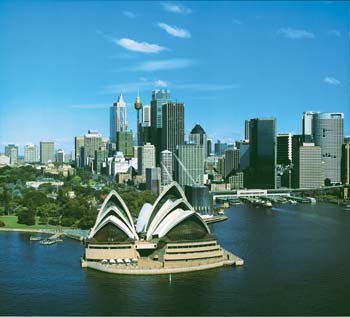
Over the past few weeks I have been reading The Saga if the Sydney Opera House by Peter Murray. The building is one of the modern wonders of the world and one of the few located in the Southern Hemisphere. It has been recognized as a World Heritage Site and is an icon of Australia.
It was designed by the Danish architect, Jorn (that ‘o’ should have a diagonal line through it) Utzon. He was very good at winning architectural competitions but few of his designs ever got built. His design won the competition in 1957.

The remit was to build a large 3000 seater concert hall come opera house with a second smaller hall to seat 1200 for theater productions. It would be rude to say that Utzon’s design was a back of a fag packet affair (fag being a British word for cigarette without the American connotation), but the design was another of those that wins competitions but doesn’t get built. Indeed in 1957 it was doubtful that it could be. The task of building it was given to another Dane, Ove Arup and Partners, consulting engineers.
The book details the difficulties there were in translating, what was obviously a beautiful design into a real three dimensional building that functioned as it should.
Although praised as a masterpiece, the Sydney Opera House has been criticized. Many people say that the acoustics are poor and that the theater doesn't have enough performance or backstage space. Yet the architectural community has been extremely supportive of Utzon and extremely critical of the Australian governmental machine and the Australian press. Most prominent articles on the Internet are supportive too.
Peter Murray is less so. He points out that the Opera House took 14 years to build and cost 14 times the original estimate. Utzon was impossible to work with and seemed astonished that he should get paid according to work done, rather than simply reimbursed what it cost to keep his Sydney office running, even when most of them were working on other projects like the Zurich concert hall. Arups, whose design solutions for the shells had made use of computer design (and remember what computers were like in the 1960s) were his constant supporters, but he even managed to fall out with them and in 1966 he resigned from the project with only the base and the shells completed. His designs for the interior were in his head with virtually nothing on paper. For the first two stages of the project he had relied on Arups to provide working drawings to build from; now he had fallen out with the engineers he had no-one capable of doing it. There were no drawings for the interior when he eventually resigned.
His resignation was really a sort of negotiating position, but David Hughes the minister responsible had had enough of Utzon. For months he had been out of contact, holidaying inn Hawaii and his offices in Sydney didn’t even have a telephone. Hughes called his bluff and assembled a committee to take his place. There were four main criticisms of Utzon: he insisted on the wrong organizational approach; he ignored questions of time; he ignored questions of cost; and he was not a practical man.
Although Utzon may have been a talented artist, he seemed to have no conception of the difficulties that sub-contractors would have in building his designs. His knowledge of acoustics was minimal and he had no idea how large an area was needed to sit in comfortably at a concert. There was no way that his large hall could accommodate both symphony concerts and opera. Eventually opera was moved to the smaller hall, but even so Sydney still has acoustic problems, especially for those 579 in the large hall who sit behind the orchestra. The total seating in the large hall was for 2679 – more than 300 short of the 3000 asked for, though they did have sufficient leg room.
The opera house was opened on October 20th 1973 by the Queen of Australia. The organ, the largest pipe organ in the world, was not completed until 1979. The final cost was 102 million Australian dollars against an original estimate of 7 million.

In 1976 Dame Edna Everage attempted to enter the Royal enclosure at Royal Acsot wearing this hat.
Saturday, October 31, 2009
Falkirk Wheel

The year 2000 marked the end of the second millennium since the supposed date of the birth of Christ. The British government set aside money from the National Lottery for several engineering works to mark the year. The best known is the Millennium Dome in London's east end, but there are others. Today I came across one I had not heard about, The Falkirk Wheel . What I like about it is that it uses engineering principles from Archimedes and cost only $25 a day to run.
Thursday, September 17, 2009
Cheating at sport

My son David is a Formula 1 engineer. One of his friends, Pat Symonds has just resigned from the Renault Formula 1 team as a consequence of the cheating by that team in last year's Singapore Grand Prix. I don't suppose I need to detail the cheating episode, but for those who are unfamiliar with motor racing let us just say that Nelson Piquet junior deliberately crashed his car so that Alonso, his team mate, could win the race. Although no-one was injured, deliberately crashing a racing car is fraught with danger and they were extremely lucky that other drivers, track marshalls and spectators were not injured. Piquet has recently been canned by Renault and has turned whistle blower. By not contesting Piquet's allegations, Renault have virtually admitted that he is speaking the truth.
This is probably the most egregious example of cheating in any sport but I wonder what others make the top ten. The 'spear tackling' of Brian O'Driscoll by two New Zealand rugby players in the 2005 Lions' tour might well have broken his neck and did remove the Lions' best player from the tour. The 'hand of God' goal by Diego Maradonna during the 1986 soccer world cup that enabled Argentina to eliminate England in the quarter finals is number 1 with most Englishmen. Maradonna was not to blame, of course, the referee should have spotted the foul. You could hardly expect a sportsman to turn down a goal scored by cheating that the referee didn't spot.
The many years of testosterone that boosted East German Olympic medals is probably the most organized and efficient example of cheating in sport, while Ben Johnson's 100 metres gold medal in 1988 is probably the most famous.
The most disgusting example is undoubtedly the Spanish entry in the intellectually disabled basketball tournament at the 2000 Summer Paralympics. The team were morally disabled, not intellectually disabled. This cheat appears at number 10 in the top 10 sporting scandals but the others are mainly in American sports that most of the rest of the world don't play, but clearly there have been cheaters in basketball, baseball and American football. However even I have heard about shoeless Joe Jackson and the Black Sox. For the non-Americans, eight players from the Chicago White Sox were allegedly bribed by gamblers to throw the 1919 World Series to the Cincinnati Reds.
Tanya Harding, the ice skater, apparently arranged to have her ex-husband beat up her arch rival Nancy Kerrigan just prior to the 1994 US championships. However in the subsequent Winter Olympics, Kerrigan won the silver medal while Harding placed eighth. Another American, Rosie Ruiz, cheated to win both the New York and Boston Marathons in 1980. In New York, she apparently rode part of the race on the subway. Another ice skating controversy occurred when French and Russians judges colluded to give Russia's Yelena Berezhnaya and Anton Sikharulidze the gold medal at the Salt Lake City Winter Olympics.
Tommy Simpson, the British cyclist died during the 1967 Tour de France. He tested positive for performance enhancing drugs. Ever since there have been numerous rumors about cycling and drugs. At one American Society for Hematology meeting I attended a session on 'Sports Hematology'. It was when erythropoietin had just been made available. The lecturer hinted strongly that the American cycling team that won gold at the Los Angeles Olympics were on EPO. Certainly, the Tour de France has been plagued by accusations and in 1998 French officials caught an employee of the Festina cycling team with a carload of performance-enhancing drugs, including EPO. Following an arrest in the case, six of Festina's nine riders conceded they had used performance-enhancing drugs, including current Credit Agricole team leader Christophe Moreau. Later that year, he tested positive for anabolic steroids.
In early 2002, Italy's Stefano Garzelli, leader of the Vini Caldirola team, tested positive for traces of probenecid, a diuretic that can be used to mask other drugs, and Spanish cyclist Igor Gonzalez de Galdeano was banned from the 2003 Tour de France after a test during the 2002 event found excessive levels of an anti-asthma drug. Then there was Floyd Landis.
Polish-American sprinter Stella Walsh was one of the fastest women on the planet. Born Stanislawa Walasiewiczowna in 1911 in Poland, she moved to Cleveland with her family when she was two, but represented Poland at the 1932 and 1936 Olympic Games. She won the gold in the 100-metres in 1932, and silver four years later.
Walsh set 20 world records and won 41 American titles in events such as sprints, long jump and throwing the discus. In 1980 she was shot and killed outside a Cleveland shopping mall. Police autopsies revealed Walsh had male genitals and both male and female chromosomes - a condition known as mosaicism. Other 'female' athletes have had some form of intersex, including, it seems, the unfortunate South African runner who has featured very recently in the press.
Ball tampering is apparently rife in both cricket and baseball. Players have used emery boards or sand to rough up one side of a ball and Vaseline to shine up the other side. England captain Michael Atherton was caught with earth in his pocket, while pitcher Joe Nickro had an emery board in his. And have you ever wondered why Australian cricketers wear so much anti-sun tan grease on their faces? Pride of place should go to Gaylord Perry was notorious for using Vaseline on his pitches, so much so that he offered to endorse the product and even named his autobiography “Me and the Spitter.” Sportscasters would comment about how they had trouble seeing the field if enough foul balls from Perry’s pitches struck the window of the booth since there would be huge grease stains where the balls hit. But the worst cricket cheat was Hansie Cronje the former South Africa captain who stunned the cricket world in 2000 by admitting he had accepted about $130,000 from bookmakers to influence the course of matches. He was subsequently banned for life. Cronje died in a plane crash in 2002 aged just 32.
In soccer feigning injury and diving have become rife in professional sport. Croation-Brazilian, Eduardo was graded an impressive 5.8 for his swallow dive for a penalty kick for Arsenal against Glasgow Celtic. FIFA banned him for two games, but later let him off, it seems on the grounds that everybody is doing it.
Perhaps the saddest cheat was Donald Crowhurst who competed in the 1968 Sunday Times Golden Globe Race, an around the world yacht race. Crowhurst was notoriously ill-prepared for the race and it became quickly apparent that all would end in disaster. He quickly realized he faced the choice of either continuing and more than likely dying, or quitting and facing financial devastation. He chose option three, which involved hanging around the South Atlantic for awhile and making false radio reports about his location. Racked with guilt, he eventually committed suicide. His boat was found adrift, along with a 25,000 word log book that included false logs, poems, quotations, and a long philosophical treatise on the human condition.
One hardly knows where to begin with the use of drugs in athletics. It now appears that not only was Ben Johnson on drugs at the Soeul Olympics but so were those who were bumped up with his disqualification, Carl Lewis, Linford Christie and Dennis Mitchell. It seems most likely that FLo-Jo, who won the women's sprints was also on steroids. Following the BALCO scandal many people doubt that any successful athlete is clean.
Do you remember Russian pentathlete Boris Onishchenko who was sent home in disgrace from the 1976 Montreal Olympics? The Soviet Army Major was disqualified for hiding an electrical switch in his fencing sword which awarded him points when he had not in fact scored.
Recently there has been something of a scandal in Rugby Union, supposedly a hooligan game played by gentlemen. Well the famous Harlequins club bent the rules by feigning a 'blood' injury. The AIDS epidemic brought in a rule that meant that a player who is bleeding may leave the field temporarily while the cut is dealt with and be substituted by another player. Dean Richards, the Harlequins' coach has been banned for three years following a fake blood injury to gain an unfair advantage. Bit feigned injuries are getting commoner in rugby. A common ploy for a team being turned over in the scrums is for one of the props to feign injury. If there is no prop on the subs bench to replace him, then scrums become dangerous and must henceforth be uncontested. This gives the losing team an advantage since they may replace a lumbering prop by a nippy back row forward.
It seems that cheating is endemic. What is the point? I find that I am very good at crosswords if I turn to the back of the book and read the answers first. The Olympics seems to a competition between our chemists and their chemists, just as the space race was a competition between their Nazi engineers and our Nazi engineers. I any sport worth watching? Perhaps the competition should be about who can come up with the most innovative ways to cheat. Here are some suggestions.
Friday, September 11, 2009
DNA
Yesterday was the 25th anniversary of the discovery of genetic fingerprinting. Despite the success of such shows as CSI, it was a British discovery. Alec Jeffreys had a "eureka moment" in his lab in Leicester after looking at the X-ray film image of a DNA experiment at 9:05 am on Monday 10 September 1984, which unexpectedly showed both similarities and differences in his technician's family's DNA. Within about half an hour, he realized the possible scope of DNA fingerprinting, which uses variations in the genetic code to identify individuals.
DNA fingerprinting was first used as a police forensic test to identify the rapist and killer of two teenagers, Lynda Mann and Dawn Ashworth, who were both murdered in Narborough, Leicestershire, in 1983 and 1986 respectively. Colin Pitchfork was identified and convicted of murder after samples taken from him matched semen samples taken from the two dead girls. In this case the chief suspect was eliminated and unsuspected Colin was pitchforked into the mire.
Alec Jeffreys is against the current British practice of including everybody on the database who has been arrested for a crime even if they have never been convicted. But then he was a hippie in his youth. You can see why the police want to keep all suspects on the database - often they are sure who did it, but they can't produce the evidence to substantiate their case. I am convinced that my every move is watched by a higher authority, so I shouldn't mind in the least having my DNA on a database.
Despite winning multiple prizes for his discoveries Jeffreys has yet to be enNobeled. Britain has a remarkable record in winning Nobel prizes with 117 awards (compared to America's 309 and Germany's 102). Of course America has a population of 307 million compared with the UK's 61 million and Germany's 82 million. Switzerland and Sweden have the best record at picking up Nobels per head of population; the Swiss with 3.57 per million and the Swedes with 3.11. Denmark is not far behind with 2.36. By the end of the century I would expect China and India to rank high on the list.
To revert to the British prizes; Among the discoveries of importance were monoclonal antibodies, antibiotics, DNA sequencing, protein structure, CT scanning, the structure of DNA, stem cells, MRI, the human genome sequence, beta blockers and H2 antagonists, NSAIDs, Pulsars, the structure of antibody molecules and the basis of organ transplantation.
DNA fingerprinting was first used as a police forensic test to identify the rapist and killer of two teenagers, Lynda Mann and Dawn Ashworth, who were both murdered in Narborough, Leicestershire, in 1983 and 1986 respectively. Colin Pitchfork was identified and convicted of murder after samples taken from him matched semen samples taken from the two dead girls. In this case the chief suspect was eliminated and unsuspected Colin was pitchforked into the mire.
Alec Jeffreys is against the current British practice of including everybody on the database who has been arrested for a crime even if they have never been convicted. But then he was a hippie in his youth. You can see why the police want to keep all suspects on the database - often they are sure who did it, but they can't produce the evidence to substantiate their case. I am convinced that my every move is watched by a higher authority, so I shouldn't mind in the least having my DNA on a database.
Despite winning multiple prizes for his discoveries Jeffreys has yet to be enNobeled. Britain has a remarkable record in winning Nobel prizes with 117 awards (compared to America's 309 and Germany's 102). Of course America has a population of 307 million compared with the UK's 61 million and Germany's 82 million. Switzerland and Sweden have the best record at picking up Nobels per head of population; the Swiss with 3.57 per million and the Swedes with 3.11. Denmark is not far behind with 2.36. By the end of the century I would expect China and India to rank high on the list.
To revert to the British prizes; Among the discoveries of importance were monoclonal antibodies, antibiotics, DNA sequencing, protein structure, CT scanning, the structure of DNA, stem cells, MRI, the human genome sequence, beta blockers and H2 antagonists, NSAIDs, Pulsars, the structure of antibody molecules and the basis of organ transplantation.
Subscribe to:
Posts (Atom)